Two years ago you worked out what needed to change.
Thirty mornings from now it's booked. Dated. With one person who is going to ask you how it went.
One short email each morning. Five minutes to read, most days something small to do. No app, no gym, no gear, no group — and nobody has to know until it's behind you.

Week 1 removes what you're carrying that you don't need. Week 2 puts you back outside, in small doses, on purpose. Week 3 you find your hard thing — not the first one you think of — and put a date on it, with a witness. Week 4 you decide what stays. About two hours a week, all up.
You know exactly what it is.
Knowing was never the hard part.
You could say it out loud right now. One sentence, no thinking, no preamble. You've known it long enough to have a shorthand for it.
Someone who spent a day in the bush with Trent put it like this:
"I have known what needed to change for a while, but finding the space to pause, make a conscious decision to direct energy to 'doing the thing' can be hard."
So it goes on the list. And the list rolls over.
Twenty years of good self-awareness. That was never going to be the thing that moved it.
You already know what it is. What you don't have is a mechanism — something outside your own head that turns the knowing into a date, and the date into a witness. That's the part nobody built for you. It's the part we built.
- —Monday comes. The plan's still good. The push to actually start it isn't there yet — again.
- —Someone asks what you've been up to, and the honest answer is quieter than you'd like it to be.
- —A mate does the thing. You mean to go. Something always gets there first.
Nothing's gone wrong. Nothing's going to.
That's not reassurance. That's the mechanism.
There's no crash coming. No scan that comes back wrong. No moment where somebody who loves you sits you down and says something. You are, by every measure anyone would check, fine.
Nobody is coming to tell you it's gone too far. That is not a job anyone has.
Which means there's no permission.
Think about every other thing you've genuinely changed. Something forced it — a deadline, a diagnosis, a relationship, a boss, a number that got too big to ignore. Something outside you moved first and you responded, which is the thing you're excellent at.
This one, nothing will move. It will sit exactly where it is, costing you nothing you can point to, for as long as you let it.
That's why it's still on the list after two years. Not laziness. No trigger.
What it costs is the years.

You're extremely well travelled and you haven't actually been anywhere.
The gap between the wins keeps getting shorter, and the wins themselves keep getting quieter.
And you can't remember last year. Not the highlights. Any of it. Not because something's wrong with your memory — because nothing occurred that was distinct enough to store.
That's not a mood. That's arithmetic, and it runs whether you engage with it or not.
Thirty days from today is a real date. So is two years from today, and if nothing moves you'll be reading a page like this one on it, recognising yourself just as accurately as you are right now.
Being right about it is not the same as it changing.
It isn't discipline. It's new data.
Everything you know about what you're made of, you found out a long time ago. Twenty, twenty-five years back. Something you did, or something that went badly and you got through it anyway. You took a reading on yourself and it came back good, and you have been running on that reading ever since.
You have not taken another one.
You've had two decades of thinking about yourself. That's not the same as finding anything out. Thinking produces interpretation. It doesn't produce evidence, and you've been going back over the same evidence since roughly 2003.
So: not clarity. Not balance. Not more insight about yourself, from the inside, from you.
New data about yourself.
Recent, first-hand, and collected on purpose.
That's what thirty mornings are for. And there's exactly one way to collect it.
This didn't come out of a book.
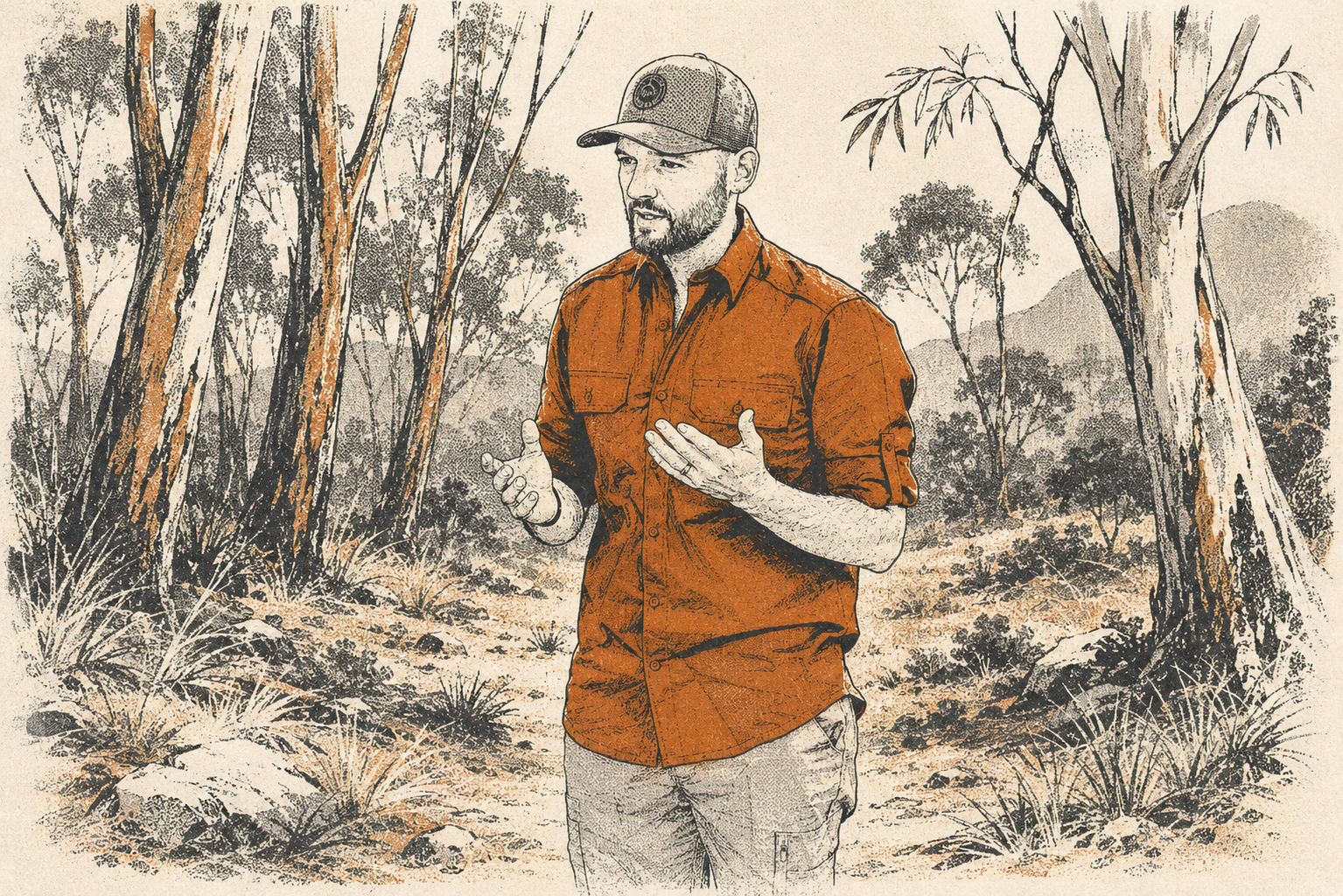
A few years ago I got properly lost in the Victorian high country. On my own, in fog, no idea which direction I'd come from.
I'd been walking for hours. Thinking hard, feeling productive, covering ground. And I'd taken in almost nothing I could use — no ridgeline, no creek, no sun. I hadn't made a single bad decision out there. I'd made no decisions, on no information, for two hours, and then needed a very good one immediately.
I stood in that fog and realised I'd just described eight years of my career.
I've written this next bit and deleted it three times.
I have three kids I adore. A wife who's better company than anyone I know. Land. Work I'm good at and no financial reason to complain about any of it.
I know how that reads. It's why I keep deleting it.
And Sunday nights were flat in a way I could not explain to a single person, because there was nothing to point at.
If that makes me sound ungrateful, I'd have agreed with you. I thought that was the whole explanation for about two years — that I was a bloke with a good life who'd developed a taste for feeling sorry for himself.
That's not what it was. But believing it was is exactly why I did nothing about it for two years.
Eight quarters — which tells you everything about how I was measuring time back then.
What eventually shifted it wasn't going bush more often. I was already doing that, and it hadn't helped, because a nice walk is a nice walk.
It was that in the fog I'd had to make a decision. Me, right then, on bad information, with something riding on it.
The first one in years.
Not the bush. Not the silence. Not the scenery. Something at stake, with an outcome I couldn't predict.
That is the one thing you cannot get out of a holiday, a book, a course, or a very good conversation. I've tried all four. I sell one of them.
— Trent
One hard thing.
It turned out there was a word for it.
I didn't have one for a long time. Then I found out other people had been circling the same thing from a completely different direction.
Dr Marcus Elliott took it somewhere new — he runs a sports science lab in Santa Barbara and has spent thirty years with NFL, NBA and Olympic athletes. He borrowed the word and gave it two rules.
That's the entire framework. Everything else about it is yours.
One hard thing. Done once. Hard enough that afterwards there's a before and an after.
Rule one is the one that matters, and it's the one people flinch at. If you're eighty per cent sure you'll manage it, you haven't built a misogi. You've built a task — and you already know how tasks go. You'll complete it, feel roughly nothing, and be exactly as informed about yourself as you were before.
The fifty per cent is what makes it an instrument instead of an achievement.
Which also means about half the people who finish these thirty days won't do the thing they booked. That's not a risk we're managing. It's the specification. If everybody finished, the design was wrong.
I worked this out standing in fog with wet feet, which is not evidence.
Michael Easter spent years on the same question and wrote the book on it. He puts it better than I'm going to:
"progressively sheltered, sterile, temperature-controlled, overfed, underchallenged, safety-netted lives"
Every one of those was something somebody fought hard to give you. Nobody is suggesting you hand them back.
But it was a genuine relief to find that a researcher had arrived where I'd arrived, with actual data behind him — because it meant I wasn't simply a bloke who'd had a moment on a mountain.
And comfort doesn't stay where you put it. It also decides how well you sleep, how much patience you've got left by six, and what your kids watch you model about hard things.
Which is why the holiday didn't fix it.
A holiday is more comfort. Comfort is what caused it.
Four things that don't exist today.
Thirty mornings from now you're not hoping it's different.
You're holding the page that makes it different.
We're new. So here's everything we've got, and nothing we haven't.
We can't show you a wall of people who did this and had their lives rearranged, because they haven't finished yet. Anyone selling you that on a product this age either has a very old product or a very flexible relationship with the truth.
What we can do is show you exactly what you're buying, and let the thing itself make the case.
Thirty emails. About twenty-seven thousand words.
That's a short book, written for one person, delivered one morning at a time in the order that makes it work. Nine hundred words a morning, five minutes to read, and not one of them is a recap of the last one.
Every one written by Trent. None of it assembled from anywhere.
And eight questions at the end that keep producing answers for years, because insights expire and questions don't.
Thirty mornings. Here's how nine of them land.
Real subject lines. Real preview text. In order.
You can look up what a misogi is in about ten seconds, and it will change nothing at all. You've looked up harder things than that and changed nothing.
What changes something is a specific morning, in a specific order, that puts you in position to do yours — and that's the one thing on this page you can't get anywhere for free.
You've had the fog story. Here's the rest of it, briefly.
I bailed on uni doing architectural engineering. Got my commercial pilot's licence and spent a while kicking meat bags out of planes, which is the industry term and not something I made up to sound interesting. Then the aerobatic licence, then I got bored of that, which I'm told is unusual.
Since: government work, defence, and I helped build the metaverse go-to-market for one of the big four. That was a real job. I hear it too.
These days I run Northentic Primal, working as a qualified executive coach with CEOs, founders and leadership teams across government, defence and private enterprise. This is the same work I do in the boardroom, just distilled to thirty mornings instead.
There's a version of me who turns up to those meetings in a pocket square and a ten-thousand-dollar watch, smelling expensive. My hunting mates have never met him and I intend to keep it that way.
What I'm actually good at
I've watched a lot of capable people arrive in the bush certain they knew what their hard thing was, and watched most of them work out by the second afternoon that they'd picked the comfortable one.
That's the bit I'm good at. Spotting it, saying so, and knowing what to ask next.
I'm not writing to you from the other side of this. I'm a few steps up the same track, and I know precisely where the mud is.
These three spent a single day in the bush with Trent.
Read what they don't say — none of them claim it changed their life. They'd had a day. This is what a day was worth.
"I didn't leave with all the answers. But I left thinking, and I've kept thinking since. That's more than I can say for any workshop I've sat through."
— CEO and Founder"The thing that stayed with me was the stillness. I haven't been able to shake it. With everything going on in a busy life and a busy career, that's rare."
— CEO, Founder, Board Chair"Trent had a knack for putting everyone at ease right from the start, which made diving into the thought-provoking content feel natural and safe."
— Director, Big FourThe thirty days are that, run thirty times, with something booked at the end of it.
What you don't need
- ✓Thirty daily emails. Five minutes each. Yours to keep.
- ✓Four weekly reckonings, one at the end of each week.
- ✓Your one hard thing — chosen, dated, with a witness.
- ✓The one page, and the eight questions that outlast it.
- ✓First email lands ten minutes after you buy.
- ✓No app. No login. No portal. No group chat.
- ✓Thirty-day money-back guarantee.
Because you're early.
It's $47 for the first group through and $97 after that. Same thirty emails, same guarantee, same everything — you're just getting it before there's a queue.
Do the thirty mornings. If on day thirty you haven't got a hard thing with a date on it, email us and we'll refund the lot. No form, no interview, no "tell us where we went wrong." You keep all thirty emails either way.
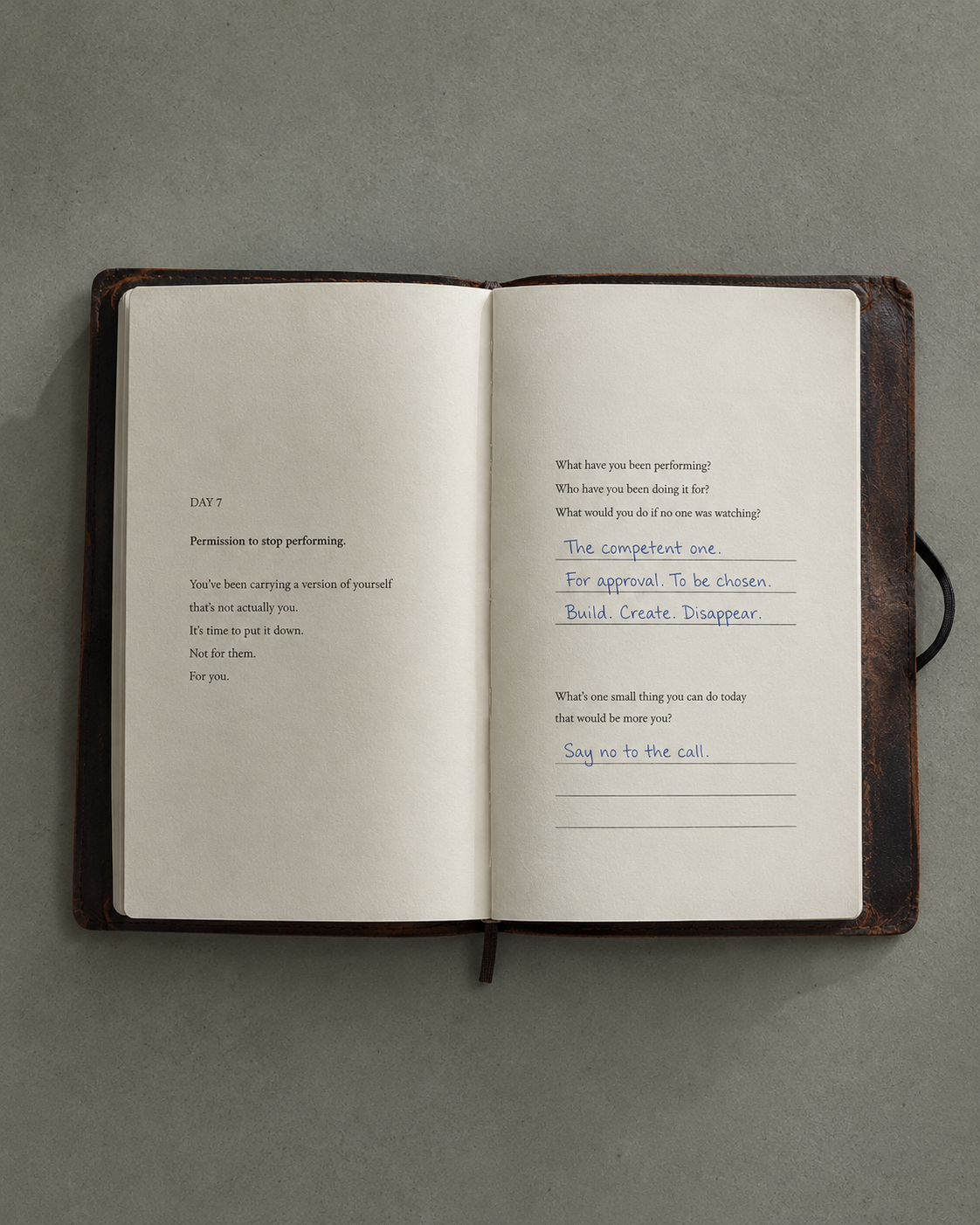
The emails disappear into your inbox. This doesn't. Every day's prompt printed on paper, with room underneath to write your answer in your own hand. Posted to your door, and still on your shelf long after the thirty days are done. Day thirty asks you to read the month back — better done from a page than a search bar.
Fair questions
You can. Most people who try pick the wrong one, and there's a specific reason the wrong one is always the first one that comes to mind. Day 15 is about nothing else. It's the morning most people say they'd have paid the forty-seven for on its own.
Not at all. The thirty days test willingness, not fitness. Your hard thing is whatever you choose, and plenty of people choose something with no gym in it anywhere.
Five minutes to read each morning. Most days something to do that's under an hour. Some days nothing at all. About two hours a week.
You have. Reading was the problem. Recognising this accurately is what you've been doing for two years, and it's the reason day thirty ends with a date and a witness rather than a summary.
No, and nothing in it suggests something's clinically wrong with you. Nothing is wrong with you. That's rather the point.
It gets one mention, on day thirty, because it's the obvious next step and hiding it would be strange. The thirty days stand on their own and most people who finish them never come on one.
Nothing happens. No streak, no flame icon, nobody watching. The emails wait in your inbox until you're ready for them.
No. It can read that way because most of the loud voices in this space are men. The last taster day ran roughly 50/50. It's written for anyone who's noticed they've stopped doing things, and that isn't a gender.

Nothing's gone wrong.
Nothing's going to go anywhere on its own, either.
You can keep waiting for something to turn up and force the issue. Nothing is going to turn up. You've had two years of evidence on that and it's very consistent.
Or you can find out, over thirty mornings, what you're actually made of — which is a question you last had an answer to about twenty years ago.
Yes, I want in →$47 · first email lands in ten minutes. Thirty-day money-back guarantee. Founding price holds until we've got testimonials, then it's $97.